

Unwanted hair has terrible timing. You shave before an event only to feel stubble returning soon after, or spend time waxing only to repeat the process a few weeks later. Laser hair removal changes that routine by targeting hair follicles with light energy, but there is an important catch: your hairs are not all growing at the same time.
That biological detail is exactly why laser hair removal requires a schedule rather than one marathon appointment. Treatments are timed around the growth cycle so new groups of actively growing hairs can be targeted as they become available.
Continue reading to learn how that cycle works, why appointments are spaced apart, and what a realistic treatment series can look like.
Your Growth Cycle Sets the Schedule
Hair may look like it simply grows, gets removed, and grows back, but each follicle follows its own biological cycle. Understanding those stages makes the timing of laser hair removal much easier to understand.
1. The Anagen Phase Creates the Best Opportunity
The anagen phase is the active growth stage. During this period, the hair is actively developing within the follicle and contains pigment that can absorb the laser’s energy. That makes anagen phase hair removal especially important.
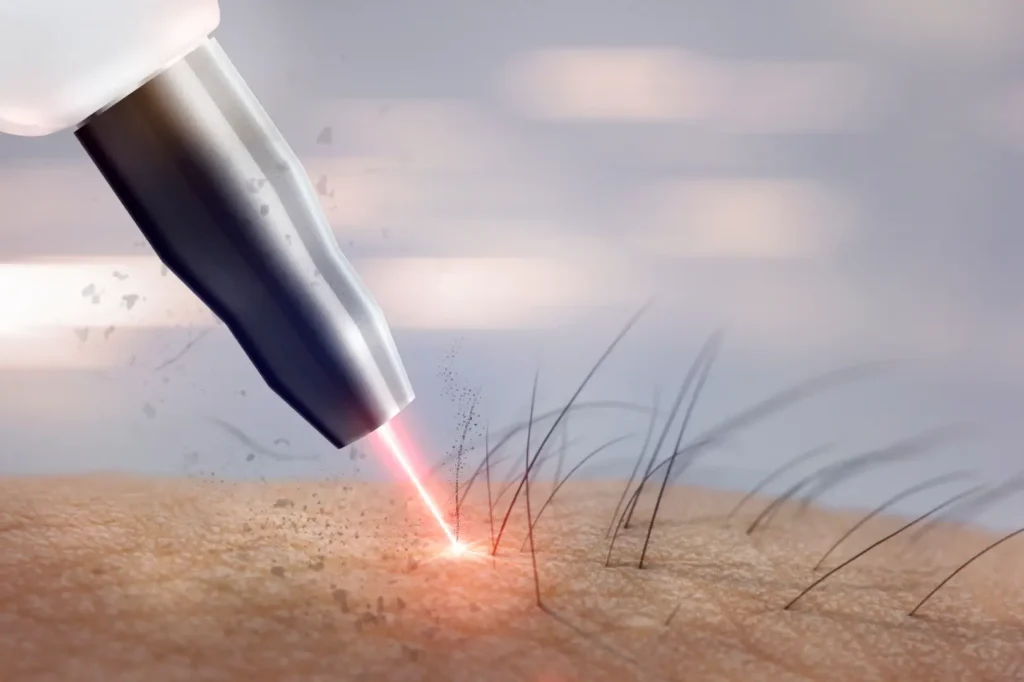
Laser hair removal works by directing light toward pigment in the hair. That energy is converted into heat, which can damage structures involved in producing future hair. The treatment is most useful when the hair and follicle are in the appropriate stage for that energy to reach its intended target.
The problem is that only a portion of hairs are in anagen at any given moment. You may look at an area and see hundreds of hairs, but their follicles are not necessarily synchronized. Some are actively growing while others are transitioning or resting. This explains one of the biggest misconceptions about laser hair removal.
Treating an entire area does not mean every follicle in that area is equally responsive during that particular appointment. Your next session is partly about waiting for another group to enter the right stage.
2. Catagen Hairs Are Already Transitioning
After active growth comes the catagen phase. This is a relatively short transitional period when the hair stops actively growing and begins separating from the structures that supported its growth.
From a laser scheduling perspective, this matters because the follicle is no longer behaving as it did during anagen. A hair may still be visible above the skin, but visibility does not necessarily mean it is an ideal laser target.
That distinction helps explain the hair growth cycle laser relationship. Providers cannot simply judge treatment potential by looking at how much hair is visible that day. Some of those hairs may be in the ideal stage. Others may already be transitioning.
This is why immediately repeating the treatment a few days later would not necessarily improve the outcome. The follicles that were not responsive during the first appointment need biological time to move through their cycles. Good timing works with that process rather than trying to force it.
3. Resting Follicles Need Time
The telogen phase is commonly described as the resting stage. During this period, active hair production has paused, and the follicle is preparing for a future growth cycle. Eventually, a new anagen phase begins. That transition is what your laser schedule is waiting for.
When someone asks why laser hair removal takes multiple sessions, the simplest answer is that resting follicles cannot all be turned into active follicles on command. The treatment series has to catch different groups as they naturally return to active growth.
This is also why a single session may produce a noticeable reduction without leaving the area permanently hair-free. The hairs successfully affected during one appointment represent only part of the total follicle population.
As additional follicles return to active growth, new hairs appear. That does not automatically mean the first treatment failed. It can simply mean another group has reached a stage where it can now be targeted.
4. Shedding Is Not the Same as New Growth
The days after treatment can be confusing if you do not know what to expect. Some treated hairs can appear as though they are continuing to grow. They may actually be working their way out of the follicle.
Over time, treated hairs can shed from the skin. Patients sometimes mistake this process for immediate regrowth and assume the laser did nothing. True new growth follows the follicle’s biological cycle.
This distinction is useful because evaluating laser hair removal too soon can create unrealistic expectations. The appearance of the area immediately after an appointment does not tell the whole story. Give the skin and treated hairs time to respond.
You may then notice that regrowth becomes patchier, finer, or less dense over the course of a treatment series. Individual responses vary, and not every follicle will react identically. The goal is progressive hair reduction rather than expecting every visible hair to disappear permanently after one visit.
5. Different Body Areas Keep Different Clocks
One reason there is no universal laser interval is that hair growth cycles vary across the body. Facial hair does not necessarily follow the same timing as leg, underarm, back, or bikini-area hair. The proportion of follicles in active growth can differ too.
That means how far apart laser sessions should be cannot be answered accurately with one interval for every treatment area. Providers commonly space appointments several weeks apart, then adjust timing according to the body area and how the patient responds. Facial areas may sometimes require different scheduling from areas where hair cycles progress more slowly.
This is why copying someone else’s laser calendar may not work for you. Your friend treating facial hair may have appointments at different intervals from someone treating their legs. Even two patients treating the same area can have differences in hair density, hormones, growth rate, and response.
A treatment schedule should follow the biology being treated rather than an arbitrary appointment package.
6. Going Too Soon Does Not Mean Faster Results
It is easy to assume that more frequent laser treatments should produce faster hair reduction. Biology makes the situation more complicated. Suppose you complete a treatment and return a week later.
Many follicles that were resting or transitioning during the first appointment may still not have entered a useful active-growth stage. Repeating the procedure prematurely would not magically make those follicles better targets.
Waiting serves a purpose. The interval allows additional hairs to cycle into active growth so the next appointment has a new population to address. This is the central reason why laser needs multiple sessions that are appropriately spaced rather than performed back-to-back.
More treatment is not automatically better treatment. Timing matters just as much as consistency.
Following the recommended schedule also gives your skin time between sessions. Your provider can assess how the area responded and determine whether the timing or treatment plan needs to change.
7. Waiting Too Long Can Slow Your Progress
If treating too frequently is not useful, does that mean you can simply wait as long as you want between appointments? Not necessarily. A laser series is designed around opportunities created by the growth cycle. Repeatedly missing scheduled sessions can stretch the overall process because fewer treatments are occurring during the planned windows.
One delayed appointment does not necessarily ruin a treatment series. Life happens, and your hair does not reset because you missed a calendar date. Still, consistency can make the process more efficient.
If you need to reschedule, ask the practice when it makes sense to return rather than automatically booking the earliest available opening. The goal is not to chase every new hair the moment it appears. It is to maintain a sensible rhythm that allows successive groups of actively growing follicles to be treated over time.
8. Your Hair Color Influences the Response
Growth stage is only one part of laser hair removal. The amount of pigment in the hair matters too. Laser systems rely on selective absorption of light energy. Darker, more heavily pigmented hair generally provides a stronger target than very light hair.
Blonde, gray, white, and some red hairs can contain less of the pigment the laser is designed to target. As a result, they may respond less predictably or poorly depending on the technology being used. This matters when estimating how many laser hair removal sessions someone might need.
Session counts should never be promised based on body area alone. Hair color, thickness, density, skin tone, hormonal influences, device selection, and treatment response can all influence the plan. A consultation helps determine whether your hair is likely to respond before you commit to a full series.
Sometimes the most useful part of that conversation is learning what laser cannot realistically accomplish.

Let Biology Set the Pace
The waiting between laser appointments is not wasted time. It is what allows another group of follicles to move into a stage where treatment may be most useful. Once you understand that, the schedule starts to make much more sense.
At Fame By You, laser hair removal can be planned around your treatment area, hair characteristics, skin, and individual response rather than forcing every patient onto the same calendar. Working with the hair growth cycle takes patience, but that timing is exactly what gives a treatment series the opportunity to create progressive, long-term hair reduction.
Connect with us today to schedule your consultation!

